
- Nicholas DiBella
- Published: July 30, 2026
- Fact-checked by Dr. Desiree Granados

Quick Summary: The FDA's July 2026 peptide hearing represented an important moment in the ongoing conversation about peptide research and compounding regulation. The advisory committee recommended that six of the seven peptides be reviewed for inclusion on the FDA's 503A Bulks List, though several recommendations were narrowly approved, reflecting ongoing debate about the available evidence.
As interest in peptide therapy has grown, so has the availability of peptides through compounding pharmacies and online marketplaces. This increased visibility has sparked important discussions about safety, quality, and regulatory oversight, prompting the FDA to hold a public hearing in July 2026 to review several peptide bulk substances.
This article provides an overview of the hearing, the peptides that were reviewed, and the committee’s recommendations. We’ll also explain what these recommendations mean within the FDA’s regulatory process and what happens next.
The FDA’s Peptide Hearing
The FDA convened its Pharmacy Compounding Advisory Committee (PCAC) to review several peptide bulk substances that have generated growing scientific and public interest. During the meeting, committee members examined FDA briefing documents, available scientific literature, expert testimony, and public comments before voting on recommendations related to each peptide.
Note that the committee’s role is advisory only. The committee cannot make final regulatory decisions, but it can provide recommendations that the FDA may consider as part of its broader evaluation process.
The committee reviewed several peptides that have been the subject of scientific research across different areas of medicine and biology. These included compounds such as:
- BPC-157, which has attracted research interest related to tissue repair and healing.
- TB-500, another peptide that has been studied in preclinical research involving tissue recovery.
- MOTS-c, which has become an area of interest in metabolic and mitochondrial research.
- Semax, a peptide that has been investigated in neurological and cognitive research.
- KPV, which has been studied for its potential role in inflammatory pathways.
- Epitalon, a peptide that has generated interest in healthy aging research.
- Emideltide (DSIP), which has been investigated in sleep-related research.
Because each peptide has its own research history and varies in terms of available scientific evidence, the committee evaluated each one individually rather than as a group.
Peptide Hearing Results: What Did the Committee Recommend?
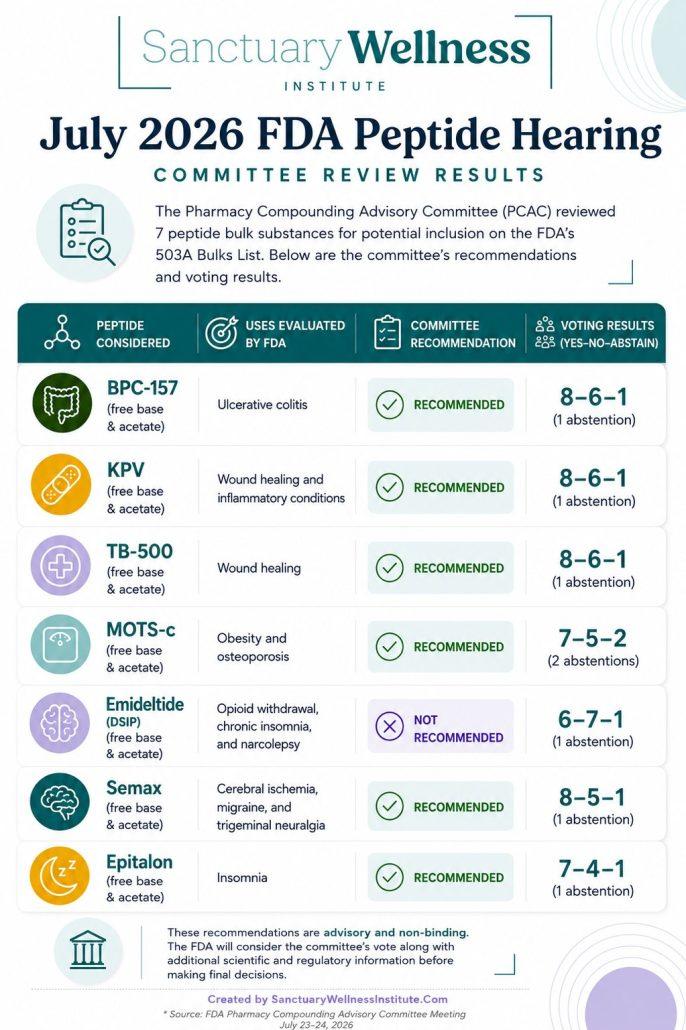
After reviewing each peptide individually, the advisory committee tallied their votes and gave their recommendation to approve 6 out of the 7 peptides in question.
The committee voted to recommend the following peptides be approved by the FDA:
However, the committee was divided on three of these peptides. BPC-157, KPV, and TB-500 each received a narrow 8-6 recommendation vote.
The committee voted against recommending Emideltide to the FDA. It was rejected in a 6-7 vote, with the committee citing a lack of clinical data as well as safety concerns regarding its effects on the central nervous system.
Why This Hearing Matters
While the hearing did not immediately change peptide availability, it marks an important milestone in the FDA’s ongoing review of compounded peptides:
- Several peptides received favorable recommendations, signaling that the committee found sufficient support to recommend their inclusion on the FDA’s 503A Bulks List.
- The FDA now has expert advisory recommendations to consider as it makes future regulatory decisions about these peptide bulk substances.
- Compounding pharmacies, healthcare providers, and patients will be watching closely, as the FDA’s final decisions could affect which peptides remain available through compounding.
- The meeting provides greater transparency into the FDA’s evaluation process, including the scientific evidence and safety considerations being weighed for each peptide.
- Additional hearings are still to come, meaning recommendations for other peptide bulk substances are expected before the FDA reaches final decisions.
What Happens Next?
The FDA will now review the committee’s recommendations, along with additional scientific evidence, public comments, and other regulatory considerations before making final decisions on these peptide bulk substances.
While the committee’s recommendations do not immediately change peptide availability, the FDA’s eventual decisions could determine whether these peptides continue to be available through compounding pharmacies.
At The Sanctuary Wellness Institute, we believe many of these peptides show meaningful therapeutic potential and, when prescribed appropriately under the supervision of licensed healthcare providers, may offer valuable treatment options for patients with limited alternatives.
We are hopeful the FDA’s final decisions will preserve access to peptides supported by the available evidence while encouraging continued research to strengthen the science behind their use.
Conclusion
The FDA’s July 2026 peptide hearing represented an important moment in the ongoing conversation about peptide research and compounding regulation. The advisory committee recommended that six of the seven peptides be reviewed for inclusion on the FDA’s 503A Bulks List, though several recommendations were narrowly approved, reflecting ongoing debate about the available evidence.
As researchers continue studying peptides and regulatory agencies continue reviewing available evidence, individuals interested in peptide therapy can benefit from following credible scientific research and official regulatory updates rather than relying solely on headlines or social media discussions.
How we reviewed this article:
- FDA.Gov (2026). Advisory Committee Meeting. July 23-24, 2026: Meeting of the Pharmacy Compounding Advisory Committee.
https://www.fda.gov/advisory-committees/advisory-committee-calendar/july-23-24-2026-meeting-pharmacy-compounding-advisory-committee-07232026 - Claire Yuan, et al. (2026). From Regeneration to Analgesia: The Role of BPC-157 in Tissue Repair and Pain Management
- https://pmc.ncbi.nlm.nih.gov/articles/PMC13026520/
- Omar F Rahman, Steven J Lee, William A Seeds (2026). Therapeutic Peptides in Orthopaedics: Applications, Challenges, and Future Directions
- https://pmc.ncbi.nlm.nih.gov/articles/PMC12753158/
- Yuejun Zheng, Zilin Wei, Tianhui Wang (2023). MOTS-c: A promising mitochondrial-derived peptide for therapeutic exploitation
https://pmc.ncbi.nlm.nih.gov/articles/PMC9905433/ - A I Radchenko, et al. (2025). The Potential of the Peptide Drug Semax and Its Derivative for Correcting Pathological Impairments in the Animal Model of Alzheimer’s Disease
https://pmc.ncbi.nlm.nih.gov/articles/PMC12755871/
Current Version
July 30, 2025
Written By
Nicholas DiBella
Fact-checked By
Dr. Desiree Granados
Editorial Process
Our Editorial Process







Nicholas DiBella received his psychology degree from West Chester University of Pennsylvania and has been writing content for the Sanctuary Wellness Institute since 2023. He is passionate about all things health & wellness.